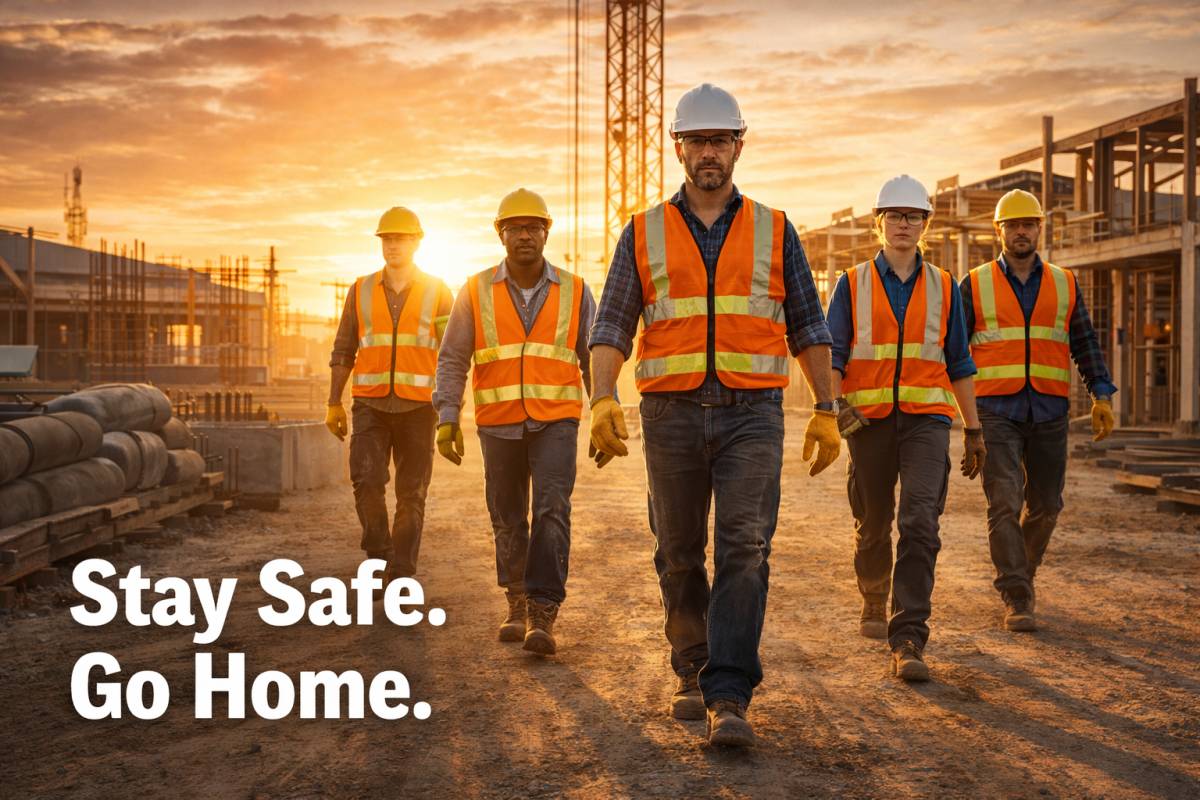
Every 15 minutes, somewhere in the world, a construction worker dies on the job. That is not a mere number. That is a father who clocked in and never came home. A young apprentice on his third week. A supervisor who said, “it will not happen on my site” — and he was wrong. Construction site safety is not a topic we can afford to treat casually, because the cost of getting it wrong is measured in human lives.
Here is the truth that every experienced person in this industry knows: most construction site accidents are preventable. Not some of them. Most of them. The falling objects, the trench collapses, the scaffold failures, the electrocutions — behind nearly every one of these tragedies is a safety step that was skipped, a rule that was ignored, or a hazard that no one bothered to report. OSHA’s fatal four data confirms that falls, struck-by objects, electrocutions, and caught-in hazards account for the vast majority of preventable construction deaths worldwide.
At Civil Dude, we believe that good construction knowledge saves lives. That is why today, I am sharing 10 practical construction site safety tips that every worker and supervisor must understand, follow, and enforce — not just when the client visits, but every single day, on every single task.
Let us get into it.
1. Always Wear Your PPE — Correctly, Not Just Present
PPE is your first line of defense on any site. However, one of the most common things you will see is workers who have their PPE with them but are not wearing it properly — helmets loose on the head, harnesses with incorrect tension, safety glasses pushed up on the forehead.
PPE that is present but worn incorrectly offers very little real protection.
Your basic construction site PPE checklist:
- Hard hat — fastened securely with the chin strap engaged
- Safety boots with steel toe caps — laced and in good condition
- High-visibility vest — worn on the outside of all other clothing
- Gloves — appropriate for the task (cut-resistant, chemical-resistant, heat-resistant)
- Eye protection — worn when cutting, grinding, drilling, or working with chemicals
Actionable Tip: At the start of every shift, supervisors must carry out a 60-second PPE inspection before any worker enters the active work zone. No correct PPE, no entry — no exceptions and no excuses.
2. Start Every Single Day With a Toolbox Talk
Before any work begins, bring the team together for a short safety briefing — commonly called a toolbox talk. This should take no more than 10 to 15 minutes, but it consistently ranks as one of the most effective construction site safety tips for reducing daily incidents.
A good toolbox talk covers:
- The specific tasks planned for that day and the hazards attached to them
- Any new or changed conditions on site since the previous shift
- Equipment to be used and any known defects or limitations
- Emergency procedures and the exact location of first aid kits
- Any near-misses or incidents from the previous day and what was learned
Actionable Tip: Rotate who leads the toolbox talk among your team members. When workers take turns leading, they pay far more attention, ask better questions, and take personal ownership of site safety.
3. Keep the Site Clean, Organised, and Clear at All Times
A disorganised site is a dangerous site. Loose materials left across walkways, tools scattered on the ground, debris piling up near work areas, and uncovered open holes are all trip, fall, and struck-by hazards — and falls consistently account for a large percentage of construction fatalities worldwide.
Good site housekeeping is not just about appearance. It is, therefore, a direct safety measure.
What good housekeeping looks like in practice:
- Clearing waste from the work area after every task — not at the end of the day
- Storing all tools and materials in their designated locations
- Immediately marking, barricading, and covering open holes and trenches
- Keeping all emergency exits, walkways, and access roads permanently clear
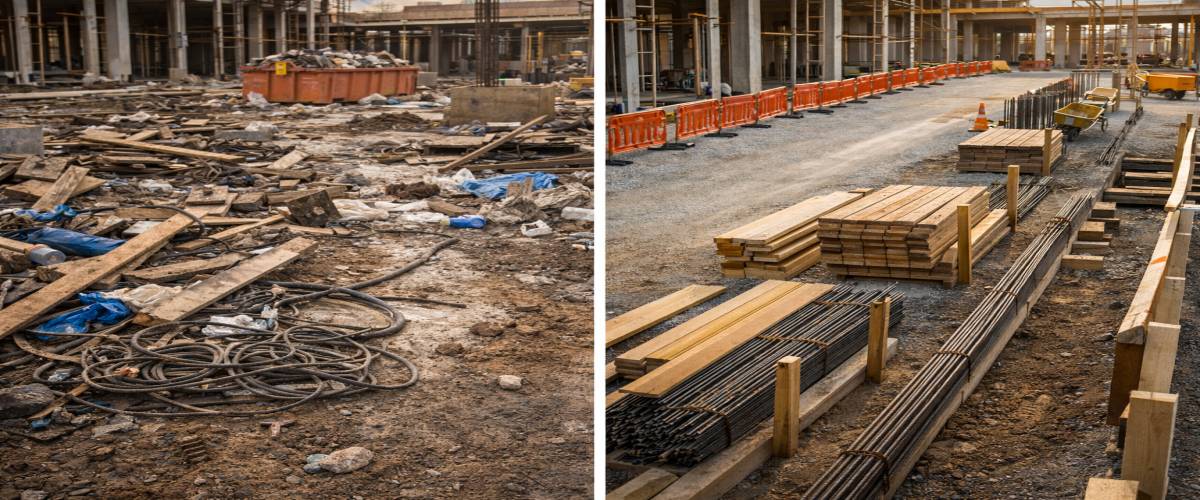
Actionable Tip: Add a “housekeeping duty” rotation to your daily schedule. Assign two workers at the end of each shift to walk the site and clear hazards. Make it a normal part of the workday — not an afterthought that only happens when a client is visiting.
4. Never Allow Solo Work in High-Risk Areas
Working alone in a confined space, at height, near live electrical equipment, or next to operating heavy machinery dramatically increases the risk of a serious or fatal injury. The reason is simple: when something goes wrong, there is no one there to help, raise the alarm, or call for assistance.
The buddy system saves lives. Consequently, it must be a non-negotiable rule on every site.
High-risk areas that require a minimum of two workers:
- Confined spaces — manholes, tanks, service tunnels, underground chambers
- Heights above 2 metres — scaffolding, rooftops, elevated platforms
- Near or around live electrical installations
- In trenches or excavations deeper than 1.5 metres
Actionable Tip: Mark all high-risk zones clearly with signage that specifically states “Two-Person Minimum.” Make this rule visible, not just verbal. A sign on the barrier is more reliable than a rule in someone’s memory.
5. Inspect All Equipment and Tools Before Every Use
A cracked scaffold plank. A worn lifting sling. A frayed cable on a power tool. These look like minor defects — until they cause a collapse, a dropped load, or an electrocution. Pre-use inspections are therefore one of the most important construction site safety tips that is consistently under-practised on busy sites.
What to check before using equipment:
- Visual damage, cracks, wear, or corrosion on all tools and equipment
- Correct labelling, certification dates, and load ratings on lifting gear
- Functioning safety guards, emergency stops, and braking systems on machinery
- Expiry dates and condition of personal safety equipment including harnesses
Actionable Tip: Create a simple, laminated pre-use inspection card for the five most commonly used pieces of equipment on your site. Attach it to the equipment. Require workers to sign it before each use — this builds accountability and creates a paper trail.
6. Train Workers on Correct Manual Handling Techniques
Back injuries are among the most common — and most life-altering — injuries sustained on construction sites. Lifting heavy blocks, carrying steel, moving bags of cement in awkward positions, and bending repeatedly over long shifts all put enormous pressure on the spine.
The damage accumulates over time, and furthermore, it rarely shows up in accident statistics because it develops gradually.
Correct manual handling technique:
- Bend at the knees — never at the back — when lifting from ground level
- Keep the load as close to your body as possible throughout the lift
- Avoid twisting the torso while carrying a load — turn with your feet instead
- Ask for assistance or use a mechanical aid for anything heavy, bulky, or awkward
Actionable Tip: During site inductions, physically demonstrate correct and incorrect lifting techniques side by side. People understand the difference much more clearly when they see it — not just when they hear about it in a presentation. For evidence-based safe lift limits, see the NIOSH lifting equation, a globally-used tool for site health and safety officers.
7. Strictly Enforce Exclusion Zones Around All Heavy Machinery
Excavators, cranes, dump trucks, and concrete mixers all have significant blind spots. Workers on foot who enter these zones — even briefly, even for a good reason — are at risk of being struck, crushed, or run over. Most machinery-related fatalities on construction sites happen because a worker was somewhere the machine operator simply could not see.
Non-negotiable exclusion zone rules:
- Never walk behind a reversing vehicle — even if it appears stationary
- Stay outside the full swing radius of excavators and cranes at all times
- Make clear eye contact with the operator before approaching any machinery
- Always follow the instructions of the banksman (spotter) — they are the eyes of the operation
Actionable Tip: Use physical barriers — cones, tape, fencing — to mark exclusion zones around all operating machinery. Never rely on workers “knowing” to stay clear. Make the boundary visible, obvious, and enforced.
8. Know the Emergency Plan — and Practice It
Every site has an emergency procedure document. Very few sites have a team that actually knows what is in it. When a serious accident happens, panic is the default response — and panic costs time that a casualty may not have.
Every worker on site, therefore, must know the basic emergency response plan — not just supervisors.
Every worker must know:
- The exact location of the nearest first aid kit and fire extinguisher
- All emergency contact numbers — site safety officer, ambulance, fire brigade
- The designated assembly point and the fastest route to reach it
- How to perform basic first aid including CPR and how to manage a bleeding wound
Actionable Tip: Post a laminated emergency information board at every site entrance and at the welfare facility. Include all emergency numbers, the physical site address (for directing ambulances), and the assembly point location. Check and update it monthly.
9. Take Heat Stress and Worker Fatigue Seriously
On construction sites across Africa and other hot-climate regions, heat stress and fatigue are two of the most underestimated safety hazards. A worker who is dehydrated, overheated, or exhausted has slower reaction times, makes poor decisions, and is significantly more likely to be involved in an accident.
Signs of heat stress to watch for:
- Dizziness, confusion, or disorientation
- Heavy sweating followed by a sudden stop in sweating
- Nausea, headache, or muscle cramps
- Pale skin and rapid, shallow breathing
Actionable Tip: The HSE Heat Stress Index is a practical tool supervisors in hot climates can use to monitor daily risk. Make water access mandatory and visible — not optional. Position water containers at each active work area, not just at the welfare facility. Supervisors should physically check during the shift that workers are drinking regularly, especially during the hottest hours of the day.
10. Build a Safety Culture — Not Just a Set of Safety Rule
Rules alone do not keep people safe on construction sites. Culture does. When workers genuinely believe that safety matters — when supervisors lead by example, when near-misses are reported openly and without blame, when everyone on site feels responsible for the person standing next to them — that is when accident rates genuinely begin to fall.
What building a safety culture looks like in practice:
- Senior staff visibly follow every safety rule — no shortcuts at the top
- Safe behaviour is recognised and acknowledged publicly
- Near-misses are reported and discussed openly — without punishment
- Workers are included in safety decisions, not just informed of them after the fact
Actionable Tip: Introduce a weekly “Safety Shoutout” — a public recognition for a worker who demonstrated outstanding safe behaviour that week. It costs nothing. It builds pride, reinforces standards, and signals loudly that safety is genuinely valued on this site.
Construction site safety is not a box you tick once a month. It is a daily commitment — from the moment you put on your helmet in the morning to the moment you sign off at the end of the shift.
The 10 construction site safety tips in this post are not complicated. They do not require expensive technology or massive budgets. They require awareness, discipline, leadership, and the willingness to hold the line even when no one is watching.
Whether you are a worker or a supervisor, you have the power to make your site safer starting today. And when every person commits to that — the accidents reduce, the productivity improves, and most importantly, people go home to their families every evening.
Ready to take site safety seriously? Explore our free construction tools at civildude.com/tools and browse more practical guides at civildude.com/blogs.
Share this post with your team. It could save a life.